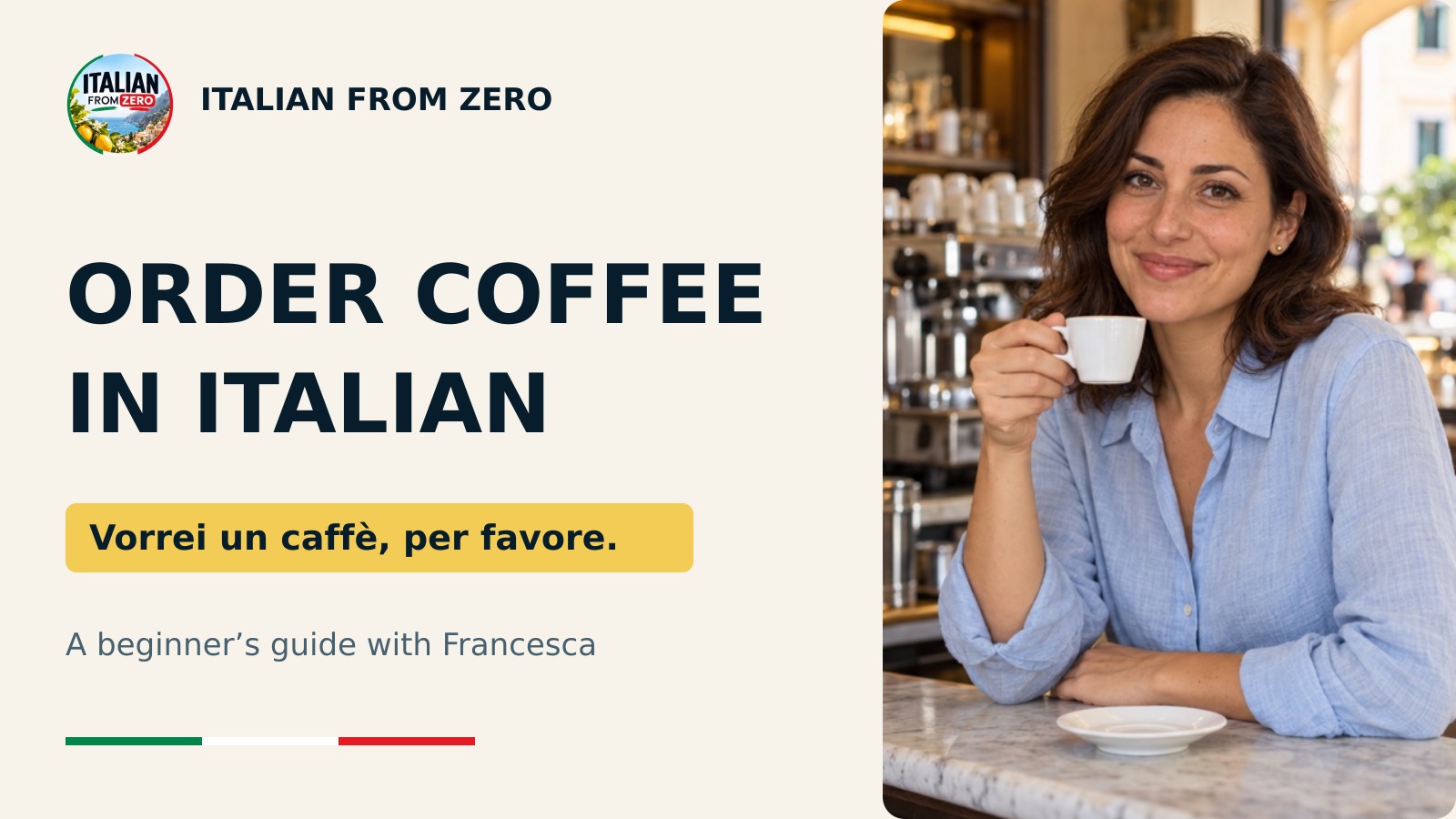
Ordering a coffee is a small conversation you can practise before you arrive in Italy. You do not need a long speech. A greeting, a polite request and a short answer can help you get started.
In this beginner lesson, you will learn how to ask for a drink, understand “Altro?”, ask the price and finish your order. Read the examples aloud, then use the practice at the end to build your own conversation. The dialogue and prices below are fictional examples for learning.
Watch the café lesson with Francesca
Watch the 7-minute lesson, then use the English explanations and Italian examples below to practise at your own pace. The video is mainly in Italian and includes listening and speaking practice.
Start with a greeting
When you enter a café in the morning, “Buongiorno” is a useful, polite greeting. You may hear the barista reply with the same word and then say “Prego”. In this situation, “Prego” invites you to speak or place your order. It can mean something like “Go ahead”.
Customer: Buongiorno.
Barista: Buongiorno. Prego.
Do not worry if you hear other words as well. Focus on the greeting and get your first sentence ready.
Use “vorrei” for a polite request
“Vorrei” means “I would like”. It is a practical starting point because you can keep the same word and change what comes after it.
Vorrei un caffè. — I would like a coffee.
Vorrei un cappuccino. — I would like a cappuccino.
Vorrei un tè. — I would like a tea.
Vorrei un cornetto. — I would like a croissant.
Add “per favore”, meaning “please”, to complete the request: “Vorrei un caffè, per favore.”
To order two things, join them with “e”, meaning “and”: “Vorrei un cappuccino e un cornetto, per favore.” Say the sentence slowly. Clear words are more useful than speaking quickly.
You can also hear “Per me, un caffè, grazie”, meaning “A coffee for me, thank you”. This works well when several people are taking turns to order. For your first practice, choose one structure and get comfortable with it.
Understand “Altro?”
After your request, the barista may ask “Altro?” This means “Anything else?” You can answer without making a new, complicated sentence.
If your order is complete:
“No, basta così, grazie.” — No, that’s all, thank you.
If you want to add something:
“Sì, anche un cornetto, per favore.” — Yes, a croissant too, please.
“Anche” means “also” or “too”. Imagine the barista asking the question, then practise both answers. This helps you prepare for a real choice instead of remembering only one fixed dialogue.
Choose where to have your drink
“Al banco o al tavolo?” means “At the counter or at a table?” You can give a short answer.
“Al banco, grazie.” — At the counter, thank you.
“Al tavolo, per favore.” — At a table, please.
Service and payment arrangements can vary between cafés. If you are unsure where to pay, ask “Dove pago?” — Where do I pay? If you want to know the price before choosing, ask about it directly. You do not need to guess how the café works.
Ask the price and pay
“Quanto costa?” means “How much does it cost?” For a specific item, say “Quanto costa un caffè?” To ask the total for your order, “Quanto viene?” is another useful question.
Practise these example answers:
“Due euro.” — Two euros.
“Due euro e cinquanta.” — Two euros and fifty cents.
“Quattro euro e cinquanta.” — Four euros and fifty cents.
To ask about paying by card, say “Posso pagare con la carta?” — Can I pay by card? If you are paying cash, you can say “Pago in contanti.” — I’m paying in cash.
“Il conto, per favore” means “The bill, please”. It is useful when asking for your bill. Follow the café’s payment procedure and ask “Dove pago?” if you need help.
A complete café conversation
Customer: Buongiorno.
Barista: Buongiorno. Prego.
Customer: Vorrei un cappuccino e un cornetto, per favore.
Barista: Certo. Altro?
Customer: No, basta così, grazie.
Barista: Al banco o al tavolo?
Customer: Al banco, grazie. Quanto viene?
Barista: Quattro euro e cinquanta.
Customer: Posso pagare con la carta?
Barista: Certo.
Customer: Grazie. Buona giornata.
Barista: Grazie, anche a lei.
The customer orders a cappuccino and a croissant, chooses the counter and asks to pay by card. “Buona giornata” means “Have a good day”; “anche a lei” is a polite “you too”.
Practise in three small steps
First, read only the customer’s lines. Next, cover them and use the barista’s lines as prompts. Finally, change the order. Ask for tea instead of a cappuccino, or ask for two coffees.
Complete these sentences before checking the answers:
A. ___ un caffè, per favore.
B. — Altro? — No, basta ___, grazie.
C. ___ costa un caffè?
D. Posso pagare con la ___?
Answers: A. Vorrei. B. così. C. Quanto. D. carta.
Now answer aloud: the barista asks “Al banco o al tavolo?” and you want a table. A model answer is “Al tavolo, per favore.”
Keep practising with Francesca
Choose one order you would really use and say it three times. On the final repetition, look away from the text. You can return to the dialogue whenever you need a reminder.
For more beginner practice, download the free Italian From Zero workbook: